
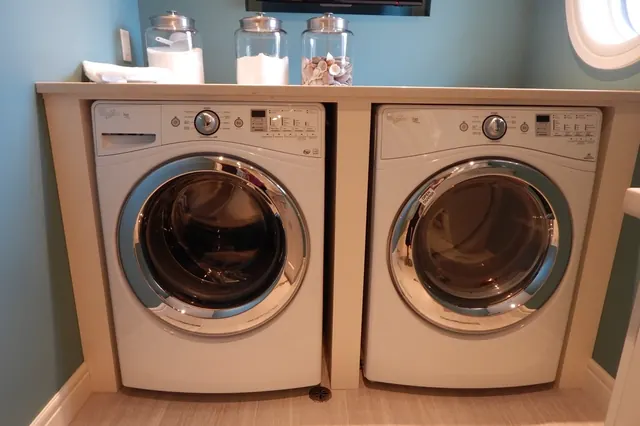
Dryer problems and their usual causes
An electric dryer is a heating element, a motor that turns the drum and blower, and a handful of safety parts that shut the heat off when things get too hot. Most dryer complaints come down to heat, airflow or the parts that hold up the drum.
| What you notice | What it usually points to |
|---|---|
| Tumbles normally, but no heat | Blown thermal fuse, open heating element, failed high-limit or cycling thermostat, or one side of the dryer's double breaker tripped |
| Heats, but takes 2 cycles to dry | Restricted vent or duct, a lint screen coated with dryer-sheet film, coated moisture sensor bars, a weak cycling thermostat, or a washer that isn't spinning clothes out |
| Light comes on, but it won't start | Door switch, start switch, broken belt (some models stop the motor when the belt breaks), thermal fuse or motor |
| Completely dead | Breaker, outlet, a burned power cord or terminal block where the cord connects, or the control |
| Motor hums but the drum doesn't turn | Broken belt, seized drum roller or idler pulley, or a failed motor |
| Squealing, thumping or scraping | Worn idler pulley, drum rollers, drum glides or felt seal, or a belt with a flat spot |
| Clothes too hot, cabinet hot to the touch | Badly restricted vent, a failed cycling thermostat, or a heating element shorted to the housing (stop using it) |
| Shuts off partway through the cycle | Motor overheating, or a thermal cutoff tripping from poor airflow |
If clothes come out of the washer dripping, look at the washer. A washer that doesn't spin fully can double drying times, and that's a washing machine repair.
Why the vent matters as much as the dryer
A dryer pushes hot, wet, lint-filled air out through its duct. When that duct is clogged, crushed or too long, the heat stays inside the dryer. That cooks the safety parts, stretches drying times and raises the fire risk.
Fire departments respond to an estimated 2,900 clothes dryer fires in U.S. homes each year, and failure to clean was the most common contributing factor, at 34 percent of those fires, according to the U.S. Fire Administration.
That's why a blown thermal fuse is rarely the whole story. The fuse blows because the dryer overheated, and it overheated because air couldn't get out.
During a dryer repair, the technician checks airflow at the back of the dryer and at the outside hood and tells you if the duct is the cause. Cleaning a long duct or rerouting one that's crushed behind the dryer can be a separate job.
Signs the vent is restricted
- Drying times have crept up over months.
- The laundry room gets hot and humid while the dryer runs.
- The flap on the outside vent hood barely opens, or lint collects around it.
- The transition duct behind the dryer is crushed, kinked or made of white vinyl.
Most dryer installation manuals call for rigid or semi-rigid metal duct and rule out plastic or vinyl. Building codes, including the Florida Building Code, limit how long a dryer exhaust duct can be and count each elbow against that length. Check your dryer's installation instructions, and ask your local building department if you're rerouting a duct.
What happens during an electric dryer repair
- Power check. The technician confirms both sides of the 240-volt supply are reaching the dryer, and looks at the cord and terminal block for heat damage.
- Airflow check. Airflow is checked at the dryer outlet and at the outside hood.
- Open the cabinet. The thermal fuse, heating element, thermostats, door switch and motor are tested with a meter. Belt, rollers, idler pulley and glides are inspected for wear.
- Repair. Failed parts are replaced. Worn drum support parts are usually replaced together so the dryer doesn't come apart again a few months later for the next worn piece. Lint built up inside the cabinet around the heater and blower gets vacuumed out while it's open.
- Test run. The dryer runs on heat while the technician checks that it heats, cycles and runs quietly.
What changes the cost of a dryer repair
Dryers are simpler machines than washers, so most repairs are moderate. The variables are the part, the cause behind it and how easy the dryer is to reach.
- Which part. A thermal fuse or thermostat is a small part. A heating element is moderate. Motors and electronic control boards are the larger repairs.
- Drum support wear. Rollers, idler pulley, belt and glides wear together. Replacing them as a set costs more than one part but saves a second visit.
- Heat damage. A dryer that ran hot for a long time may have a burned terminal block, cord or wiring to replace along with the failed part.
- Access. Stacked units and dryers in tight closets take longer to pull out and put back.
- The vent. If a restricted duct caused the failure, fixing the duct is part of making the repair last.
On an older dryer facing a motor or control board, our guide on repairing versus replacing an appliance can help you decide.
Dryer warning signs that mean stop now
Dryer problems that involve heat are fire risks. Stop using the dryer, switch off its breaker, and call if you notice any of these:
- A burning smell, or smoke from the dryer or the vent.
- Scorch marks on clothes, or a melted or discolored power cord or outlet.
- The top or sides of the dryer are too hot to keep your hand on.
- The breaker trips every time the dryer runs.
- Sparks or flashes visible through the drum's back holes.
Until it's fixed, don't run it while you're asleep or out of the house. Call (941) 393-1160; the phone is answered 24 hours a day.
A West Bradenton fire that started in a dryer vent
Dryer fires happen here too. In November 2021, a fire at the Aaron Lake Apartments in west Bradenton displaced 16 families, and officials said it appeared to have started in a dryer vent.
In apartments, condos and townhomes, the dryer vent often runs through walls or ceilings to an outlet you never see, sometimes shared with or close to a neighbor's unit. That means the part most likely to clog is the part a resident can't check. If you rent or live in a condo:
- Clean the lint screen before every load. That much is always in your hands.
- Watch for the restricted-vent signs above, and report them to your property manager or association in writing.
- Ask when the building's dryer ducts were last cleaned.
- If the dryer itself has a heat problem, it can be repaired at your unit, whether that's in West Bradenton or anywhere else in the area. The technician can tell you whether the airflow problem is in the dryer or in the building's duct.
Before the technician gets there
- Empty the dryer and clean the lint screen.
- Clear room so the dryer can be pulled out from the wall.
- Know where the dryer's breaker is in the panel.
- Make sure the outside vent hood can be reached.
- Find the model number, usually inside the door frame or on the back panel.
After the repair: keeping the fix from coming back
Clean the lint screen before every load. If you use dryer sheets, wash the screen with warm soapy water now and then; the film they leave can block airflow even when the screen looks clean.
Once in a while, check the outside flap while the dryer runs. It should open fully. If drying times start to climb again, check the duct first.
Dryer repair questions
Why does my electric dryer run but not heat?
The most common causes are a blown thermal fuse, an open heating element or a failed thermostat. Also check the breaker: an electric dryer uses a double breaker, and if one side trips, the drum can still turn while the heat stays off.
Why does my dryer keep blowing thermal fuses?
A thermal fuse is a safety part that blows when the dryer gets too hot. If it keeps blowing, something is making the dryer overheat, most often a lint-restricted vent or a failing cycling thermostat. Replacing the fuse without fixing that cause means it will blow again.
Do you repair gas dryers?
No. We work on electric dryers only. A gas dryer needs a company that services gas appliances.
How do I know if my dryer vent is clogged?
Drying times creep up, the laundry room gets hot and humid, the top of the dryer feels hotter than usual, and the flap on the outside vent hood barely opens while the dryer runs. Lint collecting around the outside hood is another sign.