
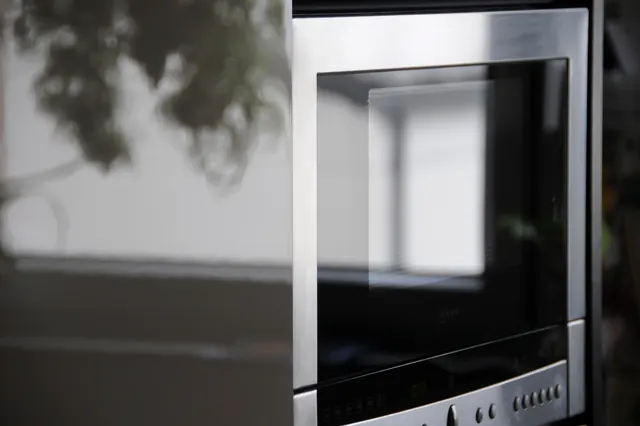
Microwave symptoms and what's behind them
A microwave heats with a magnetron powered by a high-voltage circuit (transformer, capacitor and diode), and a set of door switches makes sure it can only run with the door shut. Most failures are in that high-voltage circuit, the door switches or the controls.
| What you notice | What it usually points to |
|---|---|
| Runs, light on, plate turns, but no heat | Failed magnetron, high-voltage diode, high-voltage capacitor, transformer, or a thermal cutoff |
| Completely dead, no display | Blown internal fuse (often caused by a failed door switch), a tripped GFCI or breaker, or a control board fault |
| Blows a fuse or trips the breaker when the door opens or closes | Failed door interlock or monitor switch |
| Sparks or flashes inside | Metal inside, a grease-soaked or burned waveguide cover, chipped interior paint, or a damaged turntable roller ring |
| Turntable doesn't turn | Turntable motor, a worn coupler, or the roller ring off its track |
| Buttons don't respond, or respond wrong | Worn or moisture-damaged touchpad, or a control board fault |
| Starts by itself or won't shut off | A shorted touchpad or a stuck relay on the control board (unplug it) |
| Loud buzz or groan while heating | A failing magnetron or high-voltage diode |
| Over-the-range vent fan or cooktop light not working | Fan motor, fan switch, bulbs or bulb socket |
| Door won't latch, or the microwave runs with the door open | Broken latch hooks, door spring or interlock switches (stop using it) |
Safe checks you can do from the outside
- Power. Check the outlet's GFCI and the breaker. Over-the-range microwaves usually plug into an outlet inside the cabinet above them.
- Control lock and demo mode. A child lock or a showroom demo mode makes a microwave look broken. The manual explains how to turn either one off.
- Heat test. Heat one cup of water for one minute. If it comes out barely warm while everything else seems normal, the high-voltage circuit has a problem.
- Turntable. Lift the glass tray and reseat the roller ring and coupler.
- Waveguide cover. If it sparked, wipe grease off the small panel on the inside wall. If the panel is burned through, it needs replacing before the microwave is used again.
What a microwave repair involves
- Make it safe. The microwave is unplugged, and the high-voltage capacitor is discharged before anything inside is touched.
- Test the door switches. They're the most common cause of a dead microwave and they control whether it can run with the door open, so they get checked first.
- Test the high-voltage parts. The fuse, diode, capacitor, magnetron and transformer are tested with a meter.
- Remove it if needed. Some over-the-range repairs can be done in place; others mean lifting the microwave off its wall plate. The unit is heavy and sits between the cabinet and the range, so it comes down and goes back up carefully.
- Test. After the repair, the door latches and unlatches cleanly, the microwave heats a cup of water properly, and the vent fan and light run on over-the-range models.
What affects the cost of a microwave repair
The type of microwave matters as much as the part. Over-the-range models are usually worth repairing. With countertop models, it depends on the part.
- Over-the-range versus countertop. Replacing an over-the-range unit means a new microwave plus mounting and venting it again, so repairs make sense more often. A countertop microwave facing a major repair is often cheaper to replace.
- Which part. Door switches, fuses, turntable motors and bulbs are small repairs. Magnetrons, control boards and touchpads are the larger ones.
- Removal. Taking an over-the-range unit off the wall and remounting it adds time.
- Door damage. A broken door or latch may need a full door assembly.
- Parts for your model. Some keypads and boards are model-specific and have to be ordered.
For help weighing the numbers, see our guide on whether to repair or replace an appliance.
When to stop using a microwave right away
Microwaves combine high voltage and heat, so these signs mean unplug it now:
- A fire inside: keep the door closed, turn it off and unplug it. The fire usually goes out without air.
- Sparking that continues after metal has been removed.
- Smoke or a burning smell from the vents or the controls.
- It runs with the door open, or starts on its own.
- A door that doesn't close firmly, or one that's bent or warped. The FDA advises not operating a microwave in that condition.
Then call (941) 393-1160. Someone answers 24 hours a day.
Boiling water in the microwave during a Bradenton boil water notice
When Bradenton issues a boil water notice, as the city did citywide on July 21, 2024 after a power outage at its water treatment plant, a lot of people reach for the microwave to boil drinking water. It can be done, but there's a burn risk most people don't know about.
According to the FDA, water heated in a microwave can go past its boiling temperature without looking like it's boiling, then erupt when the cup is moved or something is dropped into it. The FDA advises not heating water longer than the manufacturer recommends.
A microwave with a turntable that has stopped turning, or one that's losing heating power, makes this worse: the water heats unevenly and takes longer, which encourages longer run times. For boiling larger amounts of water during a notice, a pot on the stove is easier to watch.
If you use the microwave, heat in short intervals, use a microwave-safe container, and let the cup sit a moment before lifting it. If the turntable is stuck or the heat test above came out weak, get it fixed before the next notice.
Before the technician arrives
- Leave it unplugged if it sparked, smoked or ran with the door open.
- Empty the microwave and the turntable.
- For over-the-range units, clear the cabinet above it and the cooktop below.
- Find the model number, usually on a label inside the door frame or on the back.
After the repair
Wipe the interior and the waveguide cover regularly, and cover food that splatters; grease buildup on that cover is a common cause of sparking. Don't run the microwave empty, since there's nothing to absorb the energy. On over-the-range models, clean or replace the grease filters under the unit so the vent fan keeps moving air.
Microwave repair questions
Is it worth repairing a microwave?
For an over-the-range microwave, often yes, because replacing one means buying the unit and having it mounted and vented again. For an inexpensive countertop model, a major repair like a magnetron or control board usually costs close to a new one, so replacing it often makes more sense. Simple repairs like a door switch or turntable motor are worth doing on either kind.
Why does my microwave spark?
Metal is the most common cause: foil, twist ties, travel mugs or dishes with metallic trim. If nothing metal is inside, look at the small cover on the inside wall (the waveguide cover).
Grease and food splatter on it can burn and arc. Chipped interior paint and a damaged turntable roller ring can also spark. Stop using it until the cause is fixed.
Can I replace the microwave fuse myself?
It isn't a good idea. The high-voltage capacitor inside can hold a dangerous charge even after the microwave is unplugged. A blown fuse also usually has a cause, often a failed door interlock switch, and a new fuse will blow again until that switch is replaced.
Why does my over-the-range microwave fan turn on by itself?
Many over-the-range microwaves have a heat sensor that turns the vent fan on when the cooktop below gets hot, to protect the microwave's electronics. That's normal. If the fan runs when the cooktop is cold, or won't turn off at all, the sensor, fan switch or control may have failed.