
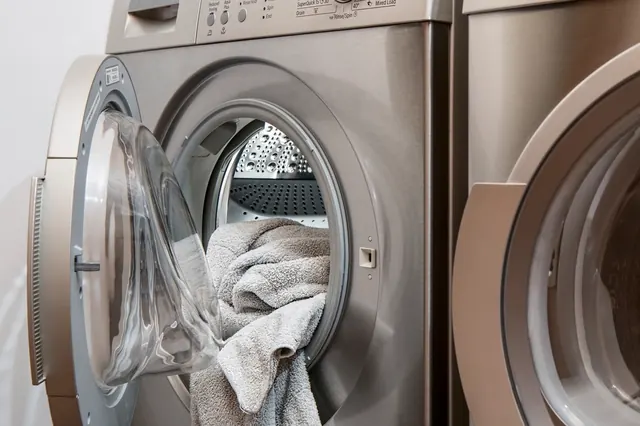
What your washer is telling you
A washer does 4 jobs: fill, agitate, drain and spin. Whichever step it gets stuck on narrows the cause to a few parts, and the table below covers the ones that come up most.
| What you notice | What it usually points to |
|---|---|
| Water left in the tub at the end of the cycle | Debris in the drain pump or pump filter, a kinked or clogged drain hose, a failed drain pump, or a clogged standpipe in the wall |
| Drains, but clothes come out soaking wet | Lid switch or door lock not registering, worn drive belt, broken motor coupler, or the washer stopping spin because the load is unbalanced |
| Won't start at all | Door lock or lid switch, a tripped GFCI or breaker, or a control board fault |
| Leak at the front, under the door | Torn or folded rubber door boot on a front-loader, or too much detergent causing suds to overflow |
| Leak at the back or underneath | Loose or cracked fill hose, failing water inlet valve, drain pump seal, loose hose clamp or a worn tub seal |
| Banging, shaking or walking on spin | Worn suspension rods, shock absorbers or springs, feet out of level, or a single heavy item throwing the load off |
| Roaring or grinding that gets louder at high speed | Worn tub bearings, often after a tub seal has let water reach them |
| Fills slowly, or not at all | Clogged screens in the inlet hoses, a failed inlet valve, or supply valves not fully open |
| Front-load door stays locked after the cycle | Water still in the drum from a drain problem, or a failed door lock |
If the washer is fine but the dryer is taking 2 cycles to finish, check whether the washer is spinning the clothes out fully. A washer that leaves clothes soaking makes any dryer look slow. If the dryer really is the problem, our electric dryer repair page covers it.
Checks you can make first
- Front-loader drain filter. On many models a small panel at the bottom front opens to a drain pump filter. Put down towels and a shallow pan before unscrewing it, because the water in the drum comes out there. Socks, coins and hair ties are the usual finds.
- Hoses behind the machine. A washer pushed back against the wall can kink its drain hose or fill hoses.
- Supply valves. Both the hot and cold valves should be fully open.
- Power. Laundry outlets are often on a GFCI. Press reset, and check the breaker.
- Level and load. Rock the washer by its corners. If it rocks, adjust the feet. Wash heavy items like rugs and comforters with a few towels to balance them.
- Detergent. High-efficiency washers need HE detergent in small amounts. Too much makes suds that leak and confuse the machine's sensors.
How a washing machine gets repaired at your home
Washer repair starts by making the problem happen. The technician runs the machine, or its built-in test mode on models that have one, to see exactly where it stops.
- Get the water out. A washer stuck full gets drained first, through the pump filter or the drain hose, so the machine can be opened safely.
- Open the cabinet. Top-loaders usually open from the top or front panel; front-loaders from the top and front. That gives access to the pump, valves, motor, belt and suspension.
- Test the suspects. The door lock or lid switch, inlet valve, drain pump and motor are checked with a meter. The belt, coupler and suspension parts are inspected for wear, and the drum is turned by hand to feel for rough bearings.
- Replace what failed. Hoses and clamps disturbed during the repair are checked and tightened.
- Run a cycle. The washer fills, drains and spins while the technician watches for leaks underneath and listens through the high-speed spin.
What drives the cost of a washer repair
A cleared drain pump or a new lid switch is a small job. Tub bearings on a front-loader are the largest repair a washer gets, and they're where repair-or-replace becomes a real question.
- The failed part. Switches, door locks, inlet valves and drain pumps are moderate. Motors and control boards cost more.
- Front-load tub work. Bearings and the tub seal sit deep inside a front-loader. Many models require taking the tub apart or replacing the whole outer tub.
- Where the washer sits. A stacked washer-dryer, a washer on a pedestal or one wedged in a tight closet takes longer to pull out and reach.
- Water damage. A leak that has been running for a while can damage the control board, wiring connectors or motor along with the original part.
- Parts for your model. Newer or less common washers may need parts ordered, which can mean a second visit.
If a big repair is on the table for an older machine, read our guide on when an appliance is worth repairing before deciding.
When a washer problem can't wait
The washer is connected to your water supply with the valves open all the time, so a leak doesn't stop when the cycle does.
- Water spreading across the floor or into another room: close both supply valves behind the washer and unplug it.
- A bulging, cracked or spraying fill hose: close the valves now. Rubber fill hoses can burst under constant pressure; many homeowners replace them with braided stainless steel hoses.
- A burning or hot electrical smell from the motor area, or smoke: stop the washer, unplug it or turn off its breaker.
- The breaker trips each time the washer starts: leave it off until it's checked.
A door locked with wet clothes inside is annoying, and the clothes can wait for the visit. Call (941) 393-1160 at any hour to set it up.
Bradenton washers that sat in floodwater
A washer that has been under floodwater should not be turned back on until it has been checked. That's a real question in Bradenton: during Hurricane Helene in September 2024, several Bradenton neighborhoods flooded, including homes around Chauncey Avenue, where one resident said water rose more than 2 feet inside the house.
Low-lying waterfront areas such as Cortez saw some of the deepest water. If your washer sits in the garage, it may be one of the first appliances water reaches.
Floodwater gets into the motor, the control board, the wiring connectors and the drain pump, and leaves silt in the pump and around the bearings. The U.S. Consumer Product Safety Commission warns against using wet electrical appliances because of shock and fire hazards.
If your washer was in floodwater
- Leave it unplugged, and don't plug it in to "see if it works." A wet board or motor can short the first time it gets power.
- If the outlet, breaker or GFCI was also under water, have an electrician deal with those first.
- Photograph the washer, the water line on the cabinet and the model tag before anything gets hauled away; insurance adjusters ask for those.
- Have it inspected. Some flooded washers can be dried out and repaired with new electrical parts. Others, especially ones that sat in salt water or for a long time, are better replaced. The inspection is how you find out which.
Before the technician arrives
- Take wet clothes out if the door or lid will open, and bail out standing water if you can do it safely.
- Clear the floor around the washer and anything stacked on top of it.
- Write down any error code and the step where the cycle stops.
- Find the model number, usually under the lid, around the door opening or on the back panel.
- If it leaks, keep the supply valves off until the visit.
After the repair: keeping it running
Check under and behind the washer during the first few loads for any drips. Keep loads balanced, measure HE detergent carefully, and clean the front-loader drain filter every few months. Leaving a front-load door cracked open between loads lets the boot dry and keeps the smell away.
Look at the fill hoses once in a while for bulges or cracks near the fittings. Those are the warning signs before a hose lets go.
Washer repair questions
Why won't my washer drain?
The water has nowhere to go: a sock, coin or hair tie in the drain pump or its filter, a kinked or clogged drain hose, or a drain pump that has failed. On many front-loaders you can reach the pump filter behind a small panel at the bottom front. If the filter is clear and the hose is straight, the pump likely needs replacing.
Why does my front-load washer smell musty?
Residue from detergent and fabric softener collects in the rubber door boot, the dispenser and the drain pump filter, and stays damp between loads. Wipe the boot, clean the filter, run the manufacturer's cleaning cycle, use HE detergent in the right amount and leave the door ajar between washes. A smell that comes back right away can point to a slow drain.
My washer bangs and moves across the floor on spin. Can it be fixed?
Usually. Start by leveling the feet and spreading the load evenly.
If it still bangs, worn suspension rods, shock absorbers or springs are the common cause, and those are replaceable. A loud roar or grinding during spin is different: that usually means worn tub bearings, which is a larger repair.
Is a washer with bad bearings worth fixing?
Sometimes. On many front-loaders the bearings are pressed into the outer tub, so replacing them means taking the tub apart or replacing the tub assembly.
On a newer washer that can be worth it. On an older one, the cost often points toward replacing the machine.